Echo repeats; reverb surrounds
An echo is heard as a distinct repeat. Reverberation forms a dense mixture of reflections that blends into a fading tail. Both involve reflected sound; the distinction concerns how we hear it. [1]
A delay effect can add a delayed copy and further repeats. A reverb effect creates a sense of surrounding reflections. A short echo and early reverb reflections can sound similar, so their names do not establish a rigid boundary. [1]
The recording may already contain space
A microphone captures a voice or instrument along with some response from the room. A bathroom recording can therefore sound different from one made in a carpeted room with curtains.
An engineer can also record close to the source and add artificial reverberation later. Some effects use algorithms; others use impulse responses, records of how a space or device responds to excitation. [4]
Adding reverb to a finished song adds space to an existing mix. Start by switching additional player effects off and listening to what the file already contains.
Three controls worth understanding
| Control | What does it change? |
|---|---|
| Dry / Wet | The balance between original sound and effect. |
| Decay | How quickly the reverb fades, shaping its tail length. |
| Pre-delay | The interval before the reverb response begins; implementation varies between effects. |
These are separate choices. Reverb can be long but quiet, or short and prominent. Turning Wet up does not replace choosing a decay time. [2] [3]
Pre-delay can separate the initial sound from the surrounding response. It can help preserve definition, but there is no single value for every voice and tempo. [4]
Listen to the same phrase
We created an original short instrumental phrase. Every file lasts 10 seconds, allowing the effect to ring out after the final note.
The original reference phrase, followed by silence.
Download WAVThree delayed copies at 300, 600 and 900 ms, with decreasing levels.
Download WAVA simple algorithmic model with a rapidly fading tail.
Download WAVThe same type of model with a much slower decay. Listen to the gaps and the end of the phrase.
Download WAVThese synthetic examples illustrate principles rather than the acoustics of a particular room. All files are mono, 48 kHz, 16-bit WAVs, with the same direct signal and common gain, without separate loudness matching. Adding an effect also increases signal energy.
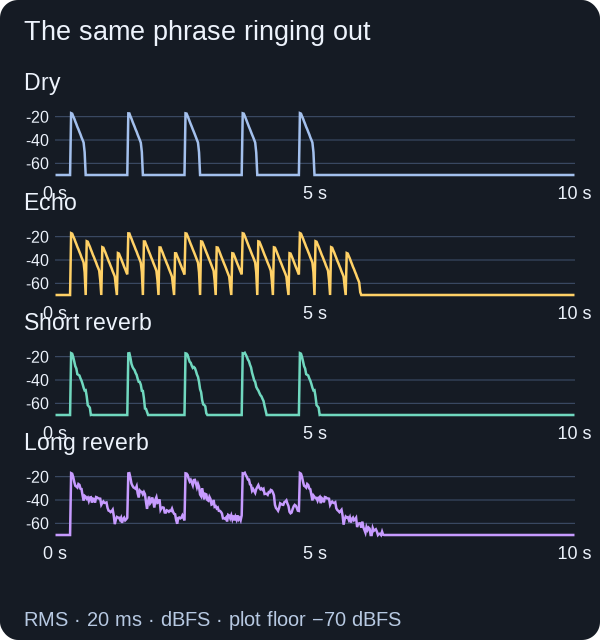
Listen after the phrase ends: the echo leaves separate replies, while reverb produces a denser decay. The chart shows measured RMS levels in successive 20-millisecond windows, using the same scale for every version.
When is there too much space?
A long tail can overlap later notes and words. That can add scale but sometimes reduce clarity, especially in fast, dense music. [4]
Switch the effect off and on during the same excerpt. Follow the attacks, vocal intelligibility and pauses between phrases. If everything blends together, first try less effect or a shorter decay.
Room size and decay time are separate properties. Materials and the shape of a space affect its reflections too. A long-tailed preset offers a particular character, not a measurement of a real hall’s dimensions. [3]
Leave room for the final sound
When exporting, listen beyond the last note. Ending the file as soon as the source stops can cut off the reverb or final echo.
Keep the dry original and export a separate listening version. For a continuous album, check adjacent track boundaries too: automatically adding silence to every file can change the arrangement.
Reverb should support the music. Choose it for the recording rather than assuming every song needs a bigger hall.