Mono and stereo describe the signal
Mono has one audio channel. You can play it through one speaker, two speakers or both headphones. In the latter two cases, each side reproduces the same information.
Stereo uses left and right channels. Differences between them let a mix position sounds across an image. Copying one channel into two creates dual mono: a two-channel file without additional spatial information. [1] [2]
Why do vocals sound centred?
When the same signal reaches both channels at the same level and time, with matching polarity, it is usually heard in the centre. Symmetrically positioned speakers can create a phantom centre. In ordinary headphones, the equivalent sound often seems to sit inside your head. [2] [3]
A mix can place a lead vocal there and move a guitar towards the left by feeding more of it to the left channel. Timing differences and reverberation also shape the sense of space. These are recording and mixing choices, so every song need not use the same arrangement. [5]
Why can a sound disappear in mono?
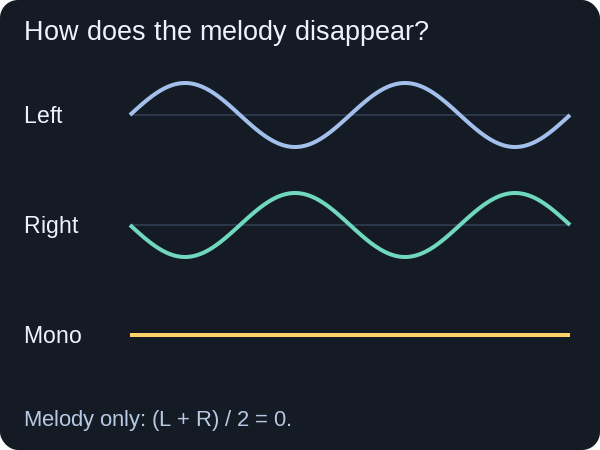
Folding stereo into mono combines the channels. If part of one channel is an inverted copy of the other, summing can weaken or completely cancel that component. [3]
In our simple example, we change the sign of the melody samples in the right channel only: positive becomes negative and vice versa. This is polarity inversion. When the channels are combined, the melody disappears while the accompaniment remains. Real mixes can have more complex relationships, so only part of a sound may weaken.
Panning an instrument left or right does not by itself create this fault. Some balance changes in mono are also natural: spatial separation no longer helps distinguish the instruments. [5]
Listen: one phrase, five versions
Use both headphones and temporarily disable mono mode and spatial effects on your device. We created an original eight-second instrumental phrase. Its main melody takes the role of a centred lead vocal.
The channels are combined and copied to both sides. The left-to-right arrangement disappears.
Download WAVMelody and bass are shared; two accompaniment parts are placed left and right.
Download WAVSide ×1.8, with Mid unchanged.
Download WAVOnly the right-channel melody is polarity-inverted. Compare its position with example 2.
Download WAVThe melody cancels while the accompaniment remains. This is the channel sum of example 4, not a manually muted instrument.
Download WAVEvery file is a two-channel, 48 kHz, 16-bit WAV. The mono examples contain identical left and right channels for convenient headphone comparison. All versions use the same source gain, without separate loudness matching. Widening and removing the melody also change signal energy; this is not a blind sound-quality ranking.
What does stereo widening change?
Widening can involve panning, increasing differences between channels, delays or other processing. Different “Width” controls need not behave alike. [4] [5]
For our third example, we multiplied the difference component, Side, by 1.8 while keeping the sum component, Mid, unchanged. Folding this particular result back into mono matches the basic version within storage rounding. That is a verified property of our examples, not a promise about every widening tool.
Wider does not automatically mean better. Listen for a clear centre and check whether the track retains its character in mono.
A quick check before exporting
- Compare stereo and mono using the same excerpt and volume setting.
- Follow individual parts: vocals, bass, snare and melody. Check whether any suddenly becomes much weaker.
- Turn widening and effects off, then enable them one at a time to identify what changes the sound.
- Keep the original. Choose mono deliberately when converting, for example when preparing single-channel speech.
A higher bitrate cannot restore spatial information discarded by a mono fold-down. Saving that result as stereo later will not recover the original placement of instruments either.
A useful stereo image makes music easier to follow. Check what remains when you combine it into one channel.